
For many Chief Financial Officers, the legacy Enterprise Resource Planning (ERP) system sitting in the server room—or a co-located data center—is a familiar “comfort” in a volatile market. It is paid for, the team knows its quirks, and it “works.” When the IT department suggests a migration to the cloud, the instinctive CFO response is often: “If it isn’t broken, why spend millions to fix it?”
However, in 2025, the phrase “it works” has become a dangerous trap. What appears to be a stable, low-cost asset is often a “leaking bucket” of hidden expenses, missed opportunities, and escalating risks. In the modern fiscal landscape, “good enough” is the most expensive strategy a company can employ.
To move from defensive accounting to strategic value creation, CFOs must look beyond the initial implementation costs and analyze the true Return on Investment (ROI) of a cloud migration.
1. The “Iceberg” of Maintenance Costs
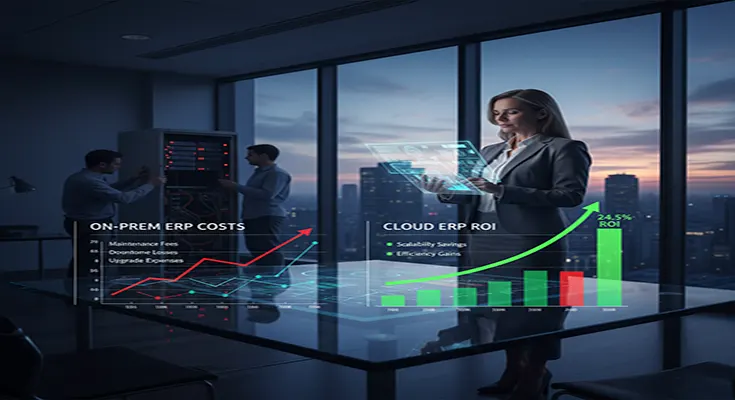
The most visible cost of a legacy ERP is the annual maintenance fee. But beneath the surface lies an iceberg of expenses that don’t appear on a single line item but erode the bottom line daily.
- The Hardware Refresh Cycle: On-premise systems require physical servers, cooling, and real estate. Every 3–5 years, a massive capital expenditure (CapEx) is required to replace aging hardware.
- The “Vulnerability Tax”: Legacy systems often lack modern security protocols. Patching these systems is a manual, labor-intensive process. The cost of a single breach—now averaging over $5 million—is a catastrophic risk that cloud-native systems mitigate through automated, multi-layered security.
- Specialized Labor Scarcity: As older ERP versions become “end-of-life,” the pool of consultants who know how to fix them shrinks. You end up paying a premium for “legacy specialists” just to keep the lights on, rather than investing in developers who can build new features.
The Cloud Pivot: Migrating shifts the budget from CapEx to OpEx. You trade unpredictable, lumpy hardware costs for a predictable, scalable subscription model that includes security, updates, and maintenance.
2. Operational Drag: The Cost of “Data Latency”
In a legacy environment, data is often siloed. Getting a consolidated view of cash flow, inventory levels across three continents, or real-west project margins often requires manual exports and “Excel gymnastics.”
- The “Closing the Books” Delay: If it takes your team 10 days to close the month because they are reconciling data from disparate legacy modules, you are operating on 10-day-old intelligence.
- The Decision Gap: In 2025, market conditions change in hours. A legacy system that provides weekly reports prevents the agility required to pivot procurement or pricing strategies in real-time.
The ROI Factor: Cloud ERPs offer a Single Source of Truth. By automating reconciliations and providing real-time dashboards, organizations often reduce their month-end close time by 30–50%. This isn’t just a time-saver; it allows the finance team to shift from “data gatherers” to “strategic advisors.”
3. The Scalability Wall
Legacy systems are built for a static world. If your company acquires a new subsidiary or expands into a new territory, a legacy ERP often requires a six-month “integration project” and additional server capacity.
- Elasticity: Cloud-native ERPs allow you to add users, entities, or modules in clicks, not months. This “elasticity” ensures that the ERP supports growth rather than acting as a bottleneck.
- Global Compliance: For companies expanding internationally, a cloud ERP automatically handles local tax laws, electronic invoicing requirements (like those in the EU and Latin America), and multi-currency reporting. Doing this manually in a legacy system is a recipe for audit failures.
4. The AI and Automation Dividend
The most significant ROI of cloud migration in 2025 is the ability to leverage Artificial Intelligence (AI) and Machine Learning (ML). Legacy systems are fundamentally incompatible with modern AI because their data structures are fragmented and inaccessible.
- Predictive Analytics: Cloud ERPs use AI to predict cash flow shortages before they happen or to flag fraudulent invoices before they are paid.
- Automated AP/AR: Robotic Process Automation (RPA) within cloud systems can handle 80% of routine invoicing and collections.
- The Talent Factor: The next generation of finance talent—Gen Z and Alpha—will refuse to work with “green screen” legacy systems. To attract high-performers, your tech stack must reflect a modern, efficient workplace.
5. Quantifying the Transition: A CFO’s Checklist
When building the business case for the Board, avoid “IT-speak.” Focus on these four quantifiable metrics:
- TCO (Total Cost of Ownership): Compare the 5-year cost of cloud (subscription + migration) vs. the 5-year cost of legacy (hardware + energy + specialized labor + patching + projected downtime).
- Productivity Gains: Calculate the labor hours saved by automating manual data entry and report generation.
- Working Capital Optimization: How much cash can be freed up by better inventory tracking and faster Accounts Receivable (AR) cycles?
- Risk Mitigation Value: Estimate the potential cost of a 48-hour system outage or a data breach on your current legacy infrastructure.
Conclusion: ERP as a Growth Engine, Not a Cost Center
The decision to migrate is rarely about the software itself; it is about the velocity of the business. A legacy ERP is an anchor; a cloud ERP is a sail.
For the CFO, the ROI of migration is found in the transition from reactive finance to predictive finance. By eliminating the hidden costs of “good enough,” you provide the organization with the agility to outpace competitors and the resilience to survive market shocks.