


The Founder’s Blueprint: Choosing Cloud Infrastructure That Won’t Break Under Your Next 1 Million Users

The Founder’s Blueprint: Choosing Cloud Infrastructure That Won’t Break Under Your Next 1 Million Users

In the early days of a startup, “scaling problems” feel like a luxury—a high-class headache you hope to have one day. But for a founder, the transition from 1,000 to 1,000,000 users is where most dreams go to die. It’s the “Chasm of Death” for infrastructure: a period where architectural shortcuts taken during the MVP phase suddenly turn into system-wide outages, skyrocketing cloud bills, and a demoralized engineering team spending 90% of their time “firefighting” instead of shipping features.

Scaling to a million users isn’t just about “buying more servers.” It’s about building a foundation that is modular, stateless, and automated. This blueprint will guide you through the critical cloud infrastructure decisions that ensure your growth is a success story, not a cautionary tale.

1. The Core Architectural Pivot: From Monolith to “Modular”

Most MVPs start as a Monolith—one single codebase and one database. It’s fast to build, but …

The Founder’s Blueprint: Choosing Cloud Infrastructure That Won’t Break Under Your Next 1 Million Users Read More
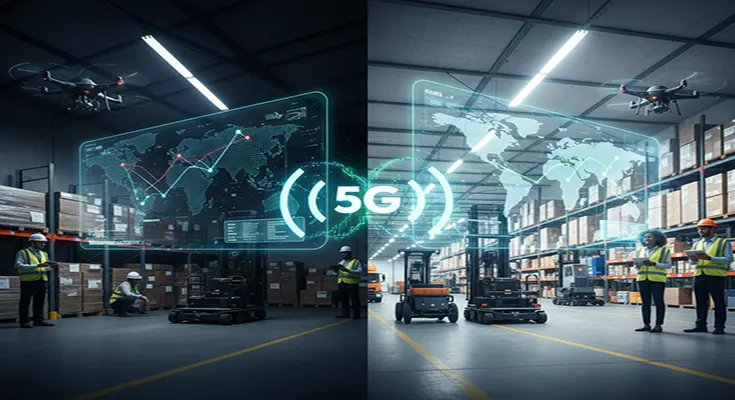

Goodbye Dead Zones: Why 5G Connectivity is the Missing Link for 100% Supply Chain Visibility

Goodbye Dead Zones: Why 5G Connectivity is the Missing Link for 100% Supply Chain Visibility

In the global theater of logistics, “visibility” has become the industry’s ultimate buzzword. Yet, for most supply chain managers, the reality is far from transparent. A shipment leaves a smart factory in Germany, enters a “dead zone” in the rural Midwest, or gets lost in the radio-frequency interference (RFI) of a massive seaport, only to reappear on the radar days later. These “black holes” in data aren’t just an annoyance—they represent billions of dollars in lost productivity, spoiled perishables, and missed delivery windows.

As we move through 2025, the limitations of 4G and Wi-Fi have reached a breaking point. The solution that is finally bridging these gaps is 5G connectivity. By providing the massive bandwidth and ultra-low latency required for truly ubiquitous tracking, 5G is the missing link that moves us from “estimated” visibility to 100% real-time certainty.

The “Dead Zone” Dilemma: Why 4G and Wi-Fi Fell Short

To …

Goodbye Dead Zones: Why 5G Connectivity is the Missing Link for 100% Supply Chain Visibility Read More
Privacy as a Competitive Advantage: Mastering Privacy-Enhancing Tech to Simplify SaaS GDPR Compliance

Privacy as a Competitive Advantage: Mastering Privacy-Enhancing Tech to Simplify SaaS GDPR Compliance

In the early days of the General Data Protection Regulation (GDPR), compliance was viewed by most SaaS founders as a “legal tax”—a necessary, expensive hurdle to clear before getting back to the “real work” of building features. However, as we move into 2025, the narrative has shifted. In an era of rampant data breaches and AI-driven surveillance, privacy is no longer just a checkbox; it is a primary product differentiator.

Enterprise buyers are no longer asking, “Are you GDPR compliant?” They are asking, “How do you protect my data at a fundamental architectural level?” For SaaS companies, the answer lies in Privacy-Enhancing Technologies (PETs).

From Compliance to Competitive Edge

The “Privacy-First” SaaS model treats data protection as a core value proposition. Companies like Apple, DuckDuckGo, and Signal have proven that users—and more importantly, high-value B2B enterprise clients—will pay a premium for the peace of mind that their data is …

Privacy as a Competitive Advantage: Mastering Privacy-Enhancing Tech to Simplify SaaS GDPR Compliance Read More
Bridging the IT Gap: How Low-Code Platforms are Empowering Non-Tech Teams to Build Custom Workflows

Bridging the IT Gap: How Low-Code Platforms are Empowering Non-Tech Teams to Build Custom Workflows

For decades, the relationship between “the business” and “IT” followed a predictable, often frustrating pattern. A marketing manager would identify a need for a custom lead-tracking tool, or an HR lead would realize their onboarding process was buried in spreadsheets. They would submit a request to IT, only to find themselves at the bottom of a six-month backlog. By the time the software was developed, the business needs had often changed, or the solution was too rigid to be useful.

This “IT gap”—the space between the demand for digital solutions and the capacity of technical teams to deliver them—is finally closing. The bridge is low-code technology.

The Rise of the “Citizen Developer”

Traditionally, building software required deep knowledge of programming languages like Java, Python, or C++. Low-code platforms change the game by using visual interfaces. Instead of writing lines of syntax, users drag and drop functional blocks to …

Bridging the IT Gap: How Low-Code Platforms are Empowering Non-Tech Teams to Build Custom Workflows Read More
Beyond the Prompt: The Top Generative AI Platforms for Scaling B2B Content Without Losing Your Brand Voice

Beyond the Prompt: The Top Generative AI Platforms for Scaling B2B Content Without Losing Your Brand Voice

In the early days of generative AI, the novelty was simply that the machine could write at all. In 2025, that novelty has worn off. For B2B organizations, the challenge has shifted from generating content to scaling it without sounding like a generic algorithm.

The “Brand Voice” is a B2B company’s most valuable intangible asset. It conveys authority, builds trust, and differentiates a solution in a crowded marketplace. When you use a “one-size-fits-all” AI prompt, you risk “brand drift”—a phenomenon where your content becomes indistinguishable from your competitors’, eroding your market position.

Scaling effectively in 2025 requires moving “beyond the prompt” and into specialized platforms that offer brand guardrails, memory, and strategic alignment. Here are the top generative AI platforms designed to scale B2B content while keeping your unique voice ironclad.

1. Writer: The Enterprise Standard for Governance

While many tools focus on the “creation” side, Writer was built from …

Beyond the Prompt: The Top Generative AI Platforms for Scaling B2B Content Without Losing Your Brand Voice Read More