

In the global theater of logistics, “visibility” has become the industry’s ultimate buzzword. Yet, for most supply chain managers, the reality is far from transparent. A shipment leaves a smart factory in Germany, enters a “dead zone” in the rural Midwest, or gets lost in the radio-frequency interference (RFI) of a massive seaport, only to reappear on the radar days later. These “black holes” in data aren’t just an annoyance—they represent billions of dollars in lost productivity, spoiled perishables, and missed delivery windows.
As we move through 2025, the limitations of 4G and Wi-Fi have reached a breaking point. The solution that is finally bridging these gaps is 5G connectivity. By providing the massive bandwidth and ultra-low latency required for truly ubiquitous tracking, 5G is the missing link that moves us from “estimated” visibility to 100% real-time certainty.
The “Dead Zone” Dilemma: Why 4G and Wi-Fi Fell Short
To understand why 5G is revolutionary, we must look at where previous technologies failed:
- Device Density: A standard 4G network can support about 10,000 devices per square mile. In a modern “Smart Warehouse” with 50,000 pallets, each tagged with an IoT sensor, the network simply collapses under the weight of the data.
- The “Metal Box” Problem: Wi-Fi signals struggle to penetrate the thick steel of shipping containers and high-density racking systems. This creates internal dead zones within the very facilities where tracking is most critical.
- Latency Gaps: In autonomous logistics—where robots and self-driving trucks must communicate—a 50-millisecond delay (typical of 4G) can be the difference between a smooth turn and a collision.
How 5G Erases the Black Holes
5G isn’t just “faster 4G”; it is a fundamental architectural shift. Three specific pillars of 5G technology are directly responsible for eliminating supply chain dead zones:
1. Massive Machine-Type Communications (mMTC)
5G can support up to 1 million devices per square kilometer. This allows logistics companies to move beyond tracking just the “truck” or the “pallet” and start tracking the individual item. When every box of pharmaceuticals or every high-end electronic component has its own low-power 5G sensor, the “granularity” of visibility reaches 100%.
2. Network Slicing and Private 5G
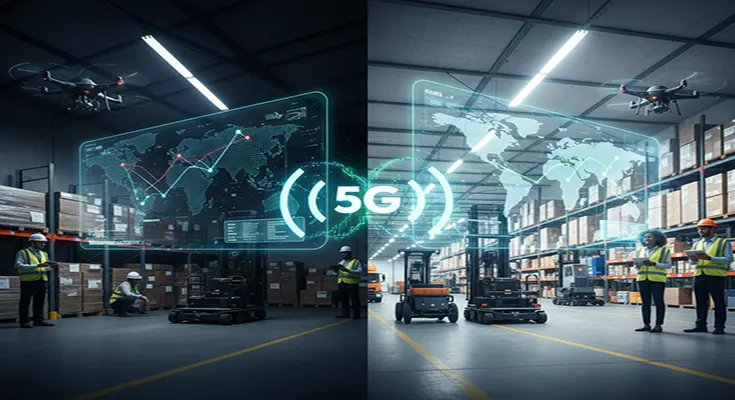
One of the most powerful tools for 2025 is the Private 5G Network. Large seaports and distribution centers are now deploying their own dedicated 5G infrastructure. Unlike public networks, these “slices” are immune to outside congestion. Even if a nearby stadium is packed with people using their phones, the warehouse’s autonomous forklifts and inventory sensors maintain a crystal-clear, high-priority connection.
3. Ultra-Reliable Low-Latency Communication (URLLC)
With latency as low as 1 millisecond, 5G enables “Tele-operations.” If a delivery drone or an automated yard truck encounters an obstacle it doesn’t recognize, a remote human operator can take control in real-time from hundreds of miles away, ensuring the flow of goods never stops.
Real-World Impact: From Port to Porch
The transition to 5G is already redefining the “End-to-End” journey of a product:
| Supply Chain Phase | The 4G/Wi-Fi Experience | The 5G Reality (2025) |
| Manufacturing | Occasional lag in sensor data; “blind spots” on the assembly line. | Digital Twin Sync: Every movement is mirrored in a virtual model in real-time. |
| The Warehouse | Dead zones between high-density racks; manual barcode scanning. | Automated Inventory: Drones and AGVs count 100% of stock with 0% downtime. |
| In Transit | Data “pings” every 15–30 minutes; loss of signal in rural areas. | Continuous Streaming: Real-time telemetry on temperature, tilt, and location. |
| Last Mile | Estimated delivery windows based on driver check-ins. | Precise Arrival: Customer knows the exact second the package will arrive. |
Predictive Visibility: Moving from Reactive to Proactive
The true power of 5G isn’t just knowing where an item is, but knowing what is about to happen. Because 5G can transmit massive amounts of data from environmental sensors (humidity, vibration, light exposure), AI engines can now predict issues before they result in a loss.
- Example: A 5G-connected sensor on a shipment of vaccines detects a 0.5-degree temperature spike while the truck is still three hours from its destination. Because the data is streamed instantly (not logged for later), the dispatcher can reroute the truck to a closer cold-storage facility immediately, saving millions of dollars in inventory.
The Economic Case: Why Now?
For years, the “cost per sensor” was the barrier. However, 5G-enabled Massive IoT is designed for low-cost, long-battery-life devices. These sensors can last up to 10 years on a single charge because they only “wake up” to send tiny bursts of data over the efficient 5G spectrum.
When you factor in the reduction in insurance premiums (due to better theft prevention), the elimination of manual inventory audits, and the optimization of fuel through real-time route adjustments, the ROI of 5G becomes undeniable.
The End of “Lost in Transit”
In the history of logistics, the “Dead Zone” was an accepted risk—a cost of doing business. 5G has officially ended that era. By providing a ubiquitous, high-capacity, and near-instantaneous data blanket, 5G is turning the “Black Box” of the supply chain into a glass pipeline.
Companies that embrace 5G-native tracking today aren’t just improving their efficiency; they are building the foundation for a fully autonomous, self-healing supply chain that never loses sight of a single bolt.